

THE TAG
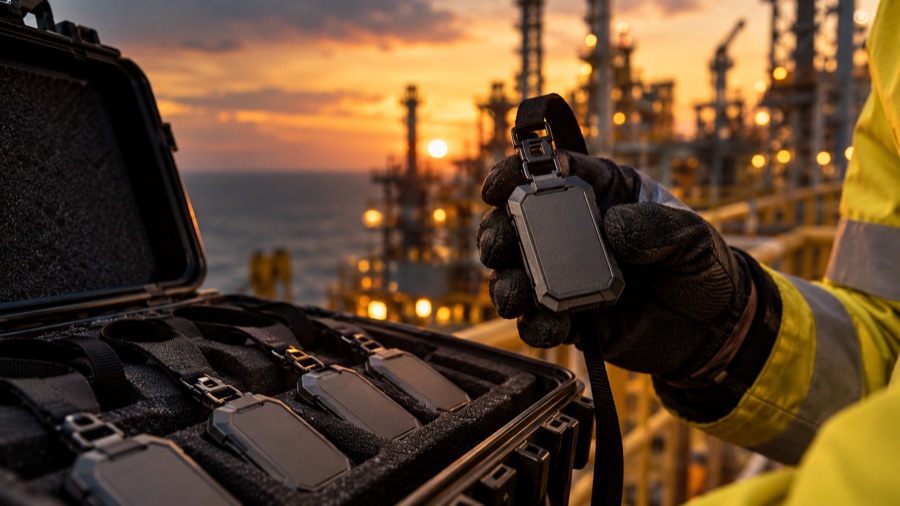
A rugged ID badge worn on the normal lanyard. Intrinsically safe, with a battery that lasts — nothing to charge nightly, no app to install, nothing to remember at shift start.
ModuTrace is a low-power wireless mesh: intrinsically safe tags, battery-powered readers that form their own network, and a live view that runs on your site. No site-wide cabling, no server room, no internet dependency.
The whole system is tags, readers and a live view. There is no separate network to build, no cabinets of equipment to house, and no software for workers to learn.
A rugged ID badge worn on the normal lanyard. Intrinsically safe, with a battery that lasts — nothing to charge nightly, no app to install, nothing to remember at shift start.
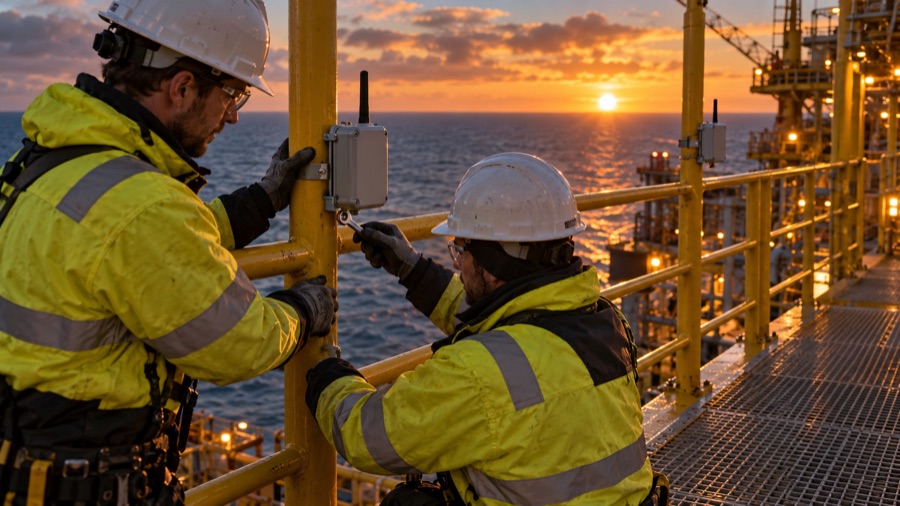
Battery-powered readers cover the zones you define and mesh with each other over a low-power wireless link. A handful of gateways carry the mesh back to the live view — everything between them stays wire-free.

Presence and headcount, zone by zone, on a live view that runs at the edge — on your site. It keeps working when the uplink doesn't. Cloud access is an option, never a dependency.
Most of the cost of a conventional tracking install is not the equipment — it is the cabling, the power runs and the disruption. A low-power mesh cuts that to a handful of powered points.
Readers run on batteries, so there are no cable trays or power runs out to the corners of the site. Power is needed only at a few gateway points — placed where power already exists.
Readers mount where you need coverage and find each other. A site goes from boxes on a pallet to a working live view in days, without stopping operations to do it.
Coverage is built one zone at a time. Start with the muster stations, add process units at the next turnaround — the mesh absorbs new readers without reconfiguration.
When the site changes — a turnaround, a new heading, a moved muster point — readers move with the work. Nothing is stranded in concrete, and nothing is paid for twice.
Readers route around a failed neighbour automatically. Coverage degrades gracefully instead of failing outright, and a swap is a bracket and a battery — not a callout.
The system answers "who is in this zone" and "is everyone at muster" — presence in the zones you define, not footstep-by-footstep tracking. Built for safety, not surveillance.
No two sites get the same kit list. We survey yours, then propose the hardware it actually needs — so the cost is as lean as the coverage allows.
Readers go where presence matters — muster stations, process units, the places a headcount has to be right — not on a grid for its own sake. The proposal lists each unit and why it is there, and the price follows the list.
Hazardous areas get the intrinsically safe tags and readers. Workshops, warehouses, offices and yards get the same system in a non-Ex variant, at a lower cost. A mixed site uses both, on one live view, and the people wearing the badges never notice the difference.
Intrinsically safe (Ex ia) — certified for Zone 0, Zone 20 and Group I mining. Not a hazardous area? The same system comes in a non-Ex variant at a lower cost, and a mixed site runs both on one live view.
Ex I M1 Ex ia I Ma
Ex II 1G Ex ia IIC T4 Ga
Ex II 1D Ex ia IIIC T200 135°C Da
Ex ia IIC T4 Ga
Ex ia IIIC T135°C Da
−20°C ≤ Ta ≤ +55°C
Cl I, II, III Div 1, Groups A–G, T4, Ex ia
Cl I Zone 0 AEx ia IIC T4 Ga
Zone 20 AEx ia IIIC T135°C Da